Verona Arena Geometry: Ellipse, Scale, and Crowd Logic
A geometry-focused exploration of Verona’s amphitheatre: ellipse parameters, cavea tiers, and spatial logic for performance and movement.
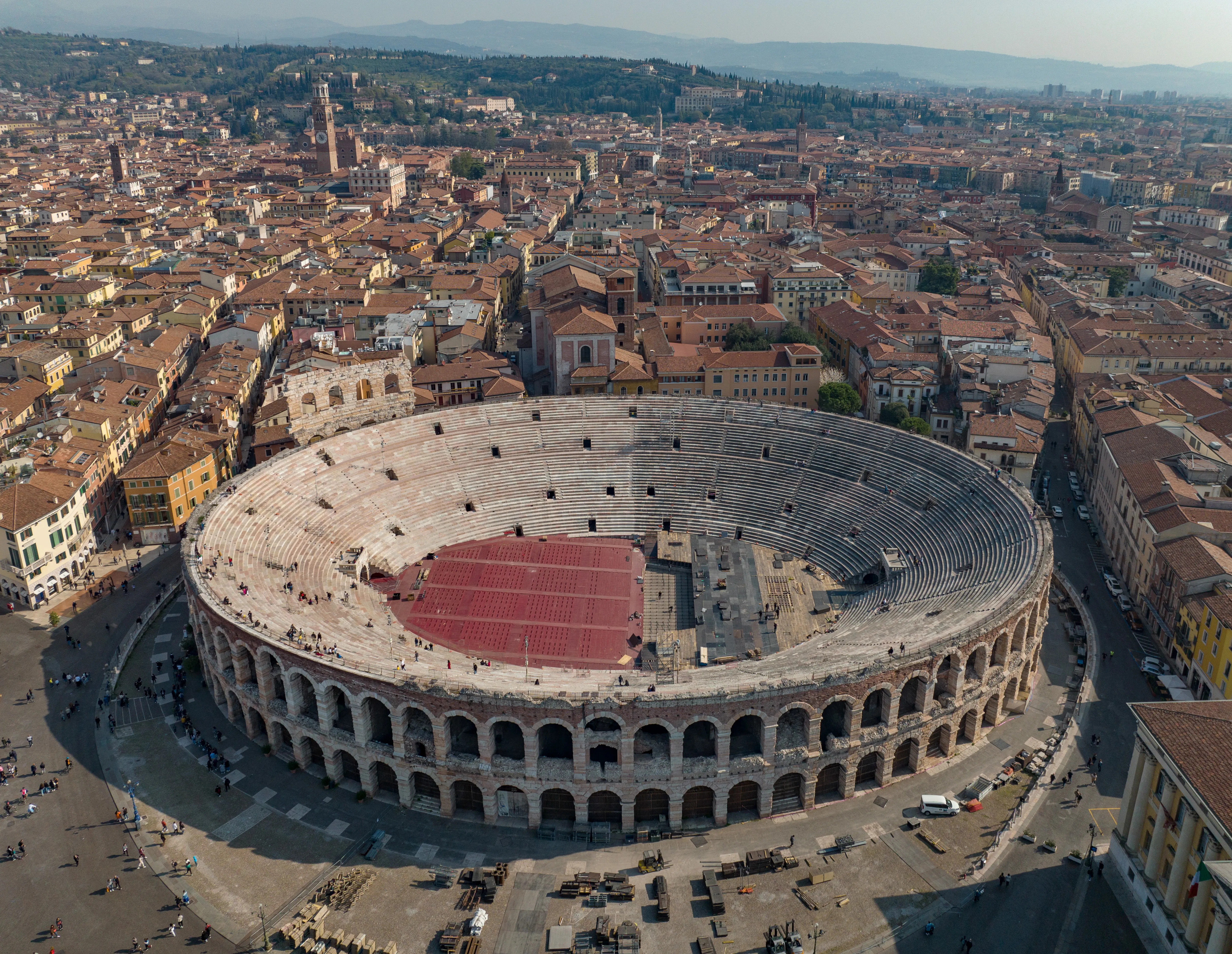
The elliptical plan of the Verona Arena mediates visibility, acoustics, and movement. The ellipse balances major and minor axes to minimize sightline obstruction while compressing sound.
Geometry Primer
Let the semi-axes be $a$ and $b$. The approximate perimeter $P$ is:
$$ P approx pi left[ 3(a+b) - sqrt{(3a+b)(a+3b)} ight] $$
The area is $A = pi a b$, guiding capacity estimates when paired with cavea tier widths.
👀 Sightlines and Rakes
- Tier rake increases towards the top to maintain clear sightlines.
- Axial symmetry ensures equitable viewing angles across sectors.
- Podium offsets prevent parapet occlusions.
- Sightline angle target ranges: $alpha in [12^circ, 15^circ]$ for comfort.
| Parameter | Intent | Effect |
|---|---|---|
| Minor axis | Proximity | Shorter distances to stage |
| Major axis | Capacity | Adds seats with minimal sightline loss |
| Rake | Visibility | Maintains overlap-free view cones |
Capacity Sketch
| Tier | Avg. riser | Rake | Relative capacity |
|---|---|---|---|
| Lower | 14–16 cm | 20–24° | Medium |
| Middle | 15–17 cm | 24–28° | High |
| Upper | 16–18 cm | 28–32° | Medium |
The ellipse suppresses acoustic hot spots typical in circular plans, while maximizing equitable sightlines.
Geometry here isn’t decorative — it’s the operating system of performance.
[^geom]: Rakes and risers vary per sector; archaeological reconstructions refine the ellipse parameters.
À propos de l’auteur

Verona Arena Editorial
Amoureux de Vérone et auteur de voyage, j’ai créé ce guide pour aider les visiteurs à saisir l’esprit de l’Arène — l’ingéniosité romaine rencontrant la musique contemporaine, dans une étreinte de pierre et de chant.
Tags
Comments (0)
Loading comments...