Complete History of the Arena di Verona
Explore the story of Verona’s Roman amphitheater — from the first century AD to the living stage of today.
Table of Contents
Roman Origins & Dedication

In the first century AD, as Verona flourished under the Roman Empire, an amphitheater rose just beyond the ancient city walls. Its builders harnessed local stone and practical genius to create a venue for spectacles that bound the community together — games, gatherings, and grand occasions staged before a broad public. The Arena’s shape and siting were intentional: an elliptical basin of seats and corridors, engineered to move crowds smoothly, to bear weight gracefully, and to let sound carry without effort.
Unlike commemorative monuments meant to be admired from a distance, the Arena was designed for entry — for the shared experience of spectacle. Dedication to public life made it durable in spirit as much as in stone: when empires faded and centuries turned, the amphitheater remained, its purpose adaptable, its presence steady, its character unmistakably Roman yet warmly Veronese. 🏛️
Construction and Engineering

Roman engineering favored clarity and endurance. The Arena’s core structure relies on concentric rings of arcades and corridors (the ‘vomitoria’) that channel visitors efficiently to their seats. Load-bearing masonry and carefully planned vaults distribute pressure outward and downward; the amphitheater’s geometry balances mass with movement, ensuring stability and ease of access even under heavy crowd conditions.
Though the great outer ring (once an elegant façade of stone) suffered catastrophic damage in the earthquake of 1117, the internal skeleton survived. This is a testament to the Romans’ preference for strong primary systems and redundancy — an amphitheater able to endure shocks and still function. Today, walking the passages and climbing the tiers reveals an engineering mind at work: graceful because it is logical, beautiful because it is sound.
Design & Architecture

The amphitheater is an ellipse, a form that maximizes visibility and acoustics. Seats rise in orderly tiers; corridors thread rhythmically through arches and vaults; light plays across warm Verona stone, softening edges at sunrise and turning them honey-gold at dusk. The Arena’s design is storytelling through geometry — guiding bodies and voices in calculated harmony so that everyone shares the event with surprising intimacy.
The surviving ‘Ala’ — a fragment of the outer ring — hints at the original exterior, a graceful shell that once encircled the amphitheater. Within, the structure remains purposeful: robust, legible, and welcoming. It is architecture that asks only that you enter, climb, and look — the rest is feeling, sound, and collective memory.
Medieval Survival & Earthquake
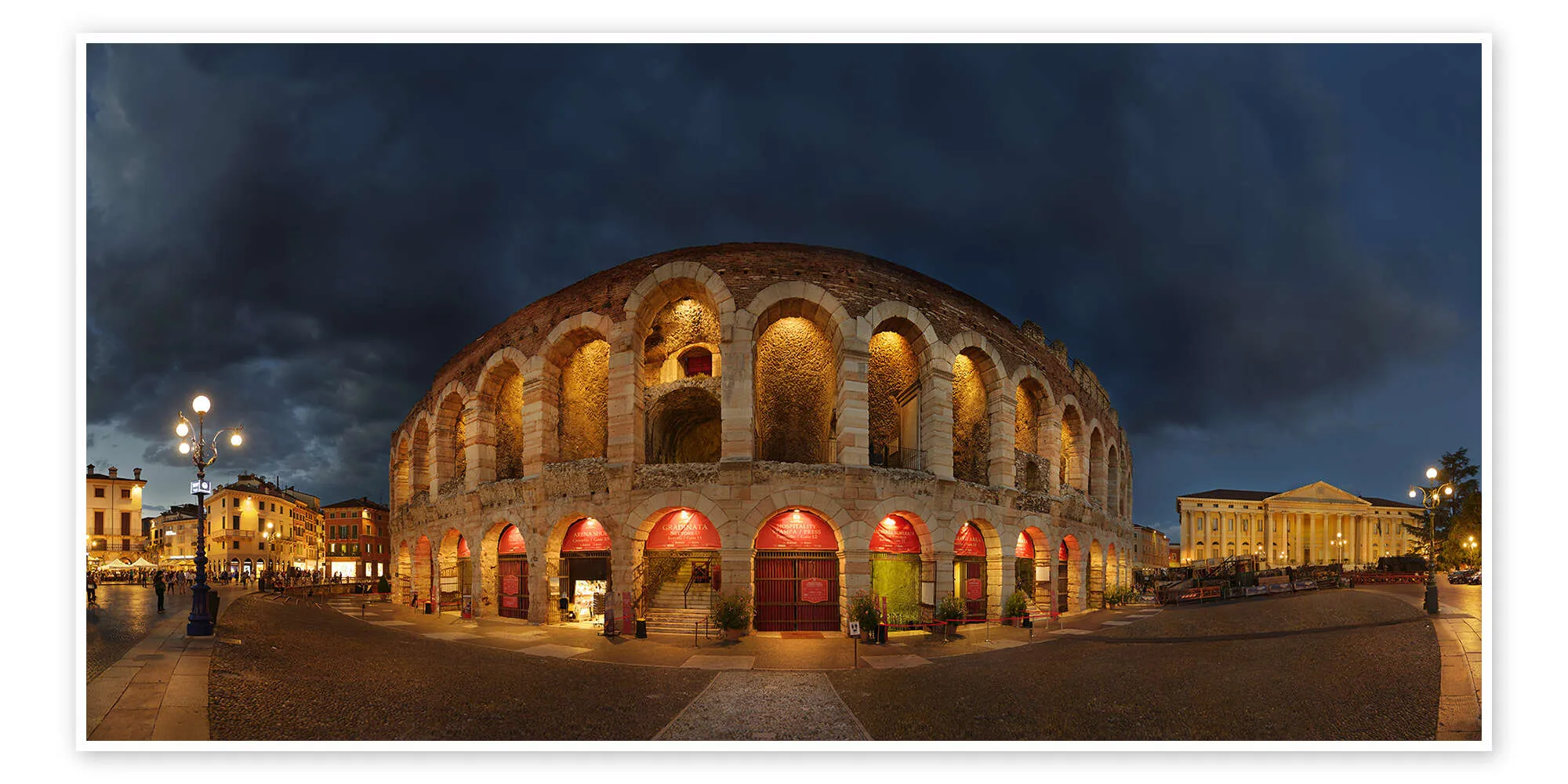
In 1117, a powerful earthquake struck Verona and the region, bringing down large portions of the Arena’s outer ring. Yet the inner structure endured, and the amphitheater remained a recognizable, usable space. Medieval and Renaissance Verona found uses for the Arena — civic gatherings, markets, even defensive functions — keeping the monument woven into daily life.
This survival is more than luck. It speaks to the Roman habit of overbuilding primary systems and the Veronese habit of cherishing useful beauty. The Arena did not lapse into ruin; it adapted. Its story is one of continuity — the city choosing, again and again, to keep the amphitheater part of itself.
Scaligeri, Venetian & Civic Eras

Under the Scaligeri and later Venetian rule, Verona developed distinctive civic pride. The Arena, though scarred, remained central — a landmark that announced the city’s Roman inheritance and resilient character. Administrations organized works to maintain access and basic stability, folding the monument into urban life rather than isolating it as a relic.
The amphitheater’s meaning matured: no longer merely a venue for ancient spectacles, it became a symbol of identity, an enduring public space with utility and dignity. This is how living monuments persist — through practical care and imaginative reuse.
19th Century Rediscovery

The 19th century brought Romantic fascination with antiquity. Scholars, travelers, and local advocates renewed attention to the Arena, documenting its fabric and encouraging sensitive repairs. Tourism began to flourish; illustrations and early photographs carried Verona’s amphitheater beyond Italy, inspiring visitors to seek its honey-colored stone and bright skies.
This rediscovery laid groundwork for the idea that the Arena could host not only crowds but culture. The dream of sound returning to the amphitheater, of performances meeting history, took shape as civic pride aligned with artistic ambition.
Opera, Spectacle & 20th Century

In 1913, to mark the centenary of Giuseppe Verdi’s birth, Verona staged Aida in the Arena — a moment that transformed ancient stone into a modern stage. The performance was a revelation: the amphitheater’s acoustics proved generous, the setting magical, the experience unforgettable. Thus began a tradition — the Arena Opera Festival — that draws audiences from around the world.
Across the 20th century, the Arena welcomed great voices and productions, balancing spectacle with respect for the place. Candles flickered, costumes shimmered, and the amphitheater’s mass seemed to lighten as music carried across tiers. The idea of the Arena as a living monument crystallized: not preserved behind ropes, but renewed night after night by applause.
Arena di Verona during WW2

World War II touched Verona, as it did all of Europe. The Arena, embedded in the city, weathered years of uncertainty. Performances paused or adapted; civic priorities shifted to survival and recovery. The amphitheater’s endurance through war underscored its role as a constant — a familiar curve of stone ready to welcome public life when peace returned.
In the postwar period, the Opera Festival revived with renewed energy, turning the Arena back into a beacon of culture and hope. The continuity felt profound: music rising where silence once weighed, community gathering where fear once scattered.
The Arena in Popular Culture

The Arena hosts not only opera but concerts and special events, becoming a recognizable stage in films, television, and recordings. Artists across genres embrace its atmosphere — the sense that sound here has history, that applause carries a memory of countless nights.
For Verona, the amphitheater is more than a backdrop. It is a character: steadfast, generous, and photogenic — a monument continually renewed by those who fill it with songs, stories, and shared moments.
Visiting Today

Today, visitors explore the Arena by day to appreciate Roman architecture and city views, then return by night for performances where tradition meets innovation. Clear signage and careful management make access straightforward; cushions, sector maps, and staff guidance support comfort across ancient seating.
The experience is wonderfully human-scale: not remote or formal, but immediate and welcoming. You ascend, you sit, and you find yourself part of a scene that has unfolded for centuries — light fading, voices rising, Verona breathing around you.
Romance & Evenings

At sunset, the Arena’s stone turns warm rose-gold — a color that seems made for romance. Couples climb the tiers, watch shadows lengthen across Piazza Bra, and feel the amphitheater draw them into easy conversation.
When night falls and performances begin, romance takes on a different tone: candlelight on faces, music in the air, a shared hush before the first notes. The Arena makes even simple evenings feel like occasions.
Nearby Verona Landmarks

Stroll to the nearby Palazzo Barbieri and Gran Guardia, explore Via Mazzini’s boutiques, or wander to Piazza delle Erbe and Juliet’s House for a layered taste of Verona’s history and charm.
Castelvecchio and its museum, the riverside walks along the Adige, and the Roman Theater across the river are within easy reach — making the Arena an ideal starting point for exploring Verona.
Cultural & National Significance

The Arena di Verona is a cornerstone of Italian cultural life — a rare fusion of ancient architecture and modern artistry that remains accessible and beloved. It symbolizes the continuity of public gathering, the pleasure of shared experience, and the resilience of cities that cherish their heritage.
It remains a living monument, sustained by performances, daily visits, and the countless personal moments of those who climb its steps, find their seats, and add their applause to a long, shimmering tapestry of nights.
Table of Contents
Roman Origins & Dedication
In the first century AD, as Verona flourished under the Roman Empire, an amphitheater rose just beyond the ancient city walls. Its builders harnessed local stone and practical genius to create a venue for spectacles that bound the community together — games, gatherings, and grand occasions staged before a broad public. The Arena’s shape and siting were intentional: an elliptical basin of seats and corridors, engineered to move crowds smoothly, to bear weight gracefully, and to let sound carry without effort.
Unlike commemorative monuments meant to be admired from a distance, the Arena was designed for entry — for the shared experience of spectacle. Dedication to public life made it durable in spirit as much as in stone: when empires faded and centuries turned, the amphitheater remained, its purpose adaptable, its presence steady, its character unmistakably Roman yet warmly Veronese. 🏛️
Construction and Engineering
Roman engineering favored clarity and endurance. The Arena’s core structure relies on concentric rings of arcades and corridors (the ‘vomitoria’) that channel visitors efficiently to their seats. Load-bearing masonry and carefully planned vaults distribute pressure outward and downward; the amphitheater’s geometry balances mass with movement, ensuring stability and ease of access even under heavy crowd conditions.
Though the great outer ring (once an elegant façade of stone) suffered catastrophic damage in the earthquake of 1117, the internal skeleton survived. This is a testament to the Romans’ preference for strong primary systems and redundancy — an amphitheater able to endure shocks and still function. Today, walking the passages and climbing the tiers reveals an engineering mind at work: graceful because it is logical, beautiful because it is sound.
Design & Architecture
The amphitheater is an ellipse, a form that maximizes visibility and acoustics. Seats rise in orderly tiers; corridors thread rhythmically through arches and vaults; light plays across warm Verona stone, softening edges at sunrise and turning them honey-gold at dusk. The Arena’s design is storytelling through geometry — guiding bodies and voices in calculated harmony so that everyone shares the event with surprising intimacy.
The surviving ‘Ala’ — a fragment of the outer ring — hints at the original exterior, a graceful shell that once encircled the amphitheater. Within, the structure remains purposeful: robust, legible, and welcoming. It is architecture that asks only that you enter, climb, and look — the rest is feeling, sound, and collective memory.
Medieval Survival & Earthquake
In 1117, a powerful earthquake struck Verona and the region, bringing down large portions of the Arena’s outer ring. Yet the inner structure endured, and the amphitheater remained a recognizable, usable space. Medieval and Renaissance Verona found uses for the Arena — civic gatherings, markets, even defensive functions — keeping the monument woven into daily life.
This survival is more than luck. It speaks to the Roman habit of overbuilding primary systems and the Veronese habit of cherishing useful beauty. The Arena did not lapse into ruin; it adapted. Its story is one of continuity — the city choosing, again and again, to keep the amphitheater part of itself.
Scaligeri, Venetian & Civic Eras
Under the Scaligeri and later Venetian rule, Verona developed distinctive civic pride. The Arena, though scarred, remained central — a landmark that announced the city’s Roman inheritance and resilient character. Administrations organized works to maintain access and basic stability, folding the monument into urban life rather than isolating it as a relic.
The amphitheater’s meaning matured: no longer merely a venue for ancient spectacles, it became a symbol of identity, an enduring public space with utility and dignity. This is how living monuments persist — through practical care and imaginative reuse.
19th Century Rediscovery
The 19th century brought Romantic fascination with antiquity. Scholars, travelers, and local advocates renewed attention to the Arena, documenting its fabric and encouraging sensitive repairs. Tourism began to flourish; illustrations and early photographs carried Verona’s amphitheater beyond Italy, inspiring visitors to seek its honey-colored stone and bright skies.
This rediscovery laid groundwork for the idea that the Arena could host not only crowds but culture. The dream of sound returning to the amphitheater, of performances meeting history, took shape as civic pride aligned with artistic ambition.
Opera, Spectacle & 20th Century
In 1913, to mark the centenary of Giuseppe Verdi’s birth, Verona staged Aida in the Arena — a moment that transformed ancient stone into a modern stage. The performance was a revelation: the amphitheater’s acoustics proved generous, the setting magical, the experience unforgettable. Thus began a tradition — the Arena Opera Festival — that draws audiences from around the world.
Across the 20th century, the Arena welcomed great voices and productions, balancing spectacle with respect for the place. Candles flickered, costumes shimmered, and the amphitheater’s mass seemed to lighten as music carried across tiers. The idea of the Arena as a living monument crystallized: not preserved behind ropes, but renewed night after night by applause.
Arena di Verona during WW2
World War II touched Verona, as it did all of Europe. The Arena, embedded in the city, weathered years of uncertainty. Performances paused or adapted; civic priorities shifted to survival and recovery. The amphitheater’s endurance through war underscored its role as a constant — a familiar curve of stone ready to welcome public life when peace returned.
In the postwar period, the Opera Festival revived with renewed energy, turning the Arena back into a beacon of culture and hope. The continuity felt profound: music rising where silence once weighed, community gathering where fear once scattered.
The Arena in Popular Culture
The Arena hosts not only opera but concerts and special events, becoming a recognizable stage in films, television, and recordings. Artists across genres embrace its atmosphere — the sense that sound here has history, that applause carries a memory of countless nights.
For Verona, the amphitheater is more than a backdrop. It is a character: steadfast, generous, and photogenic — a monument continually renewed by those who fill it with songs, stories, and shared moments.
Visiting Today
Today, visitors explore the Arena by day to appreciate Roman architecture and city views, then return by night for performances where tradition meets innovation. Clear signage and careful management make access straightforward; cushions, sector maps, and staff guidance support comfort across ancient seating.
The experience is wonderfully human-scale: not remote or formal, but immediate and welcoming. You ascend, you sit, and you find yourself part of a scene that has unfolded for centuries — light fading, voices rising, Verona breathing around you.
Romance & Evenings
At sunset, the Arena’s stone turns warm rose-gold — a color that seems made for romance. Couples climb the tiers, watch shadows lengthen across Piazza Bra, and feel the amphitheater draw them into easy conversation.
When night falls and performances begin, romance takes on a different tone: candlelight on faces, music in the air, a shared hush before the first notes. The Arena makes even simple evenings feel like occasions.
Nearby Verona Landmarks
Stroll to the nearby Palazzo Barbieri and Gran Guardia, explore Via Mazzini’s boutiques, or wander to Piazza delle Erbe and Juliet’s House for a layered taste of Verona’s history and charm.
Castelvecchio and its museum, the riverside walks along the Adige, and the Roman Theater across the river are within easy reach — making the Arena an ideal starting point for exploring Verona.
Cultural & National Significance
The Arena di Verona is a cornerstone of Italian cultural life — a rare fusion of ancient architecture and modern artistry that remains accessible and beloved. It symbolizes the continuity of public gathering, the pleasure of shared experience, and the resilience of cities that cherish their heritage.
It remains a living monument, sustained by performances, daily visits, and the countless personal moments of those who climb its steps, find their seats, and add their applause to a long, shimmering tapestry of nights.