How Verona’s Arena Was Built: Roman Methods and Materials
A detailed look at the Verona Arena’s Roman construction: quarries, masonry, vaults, logistics, and the structural system behind its longevity.
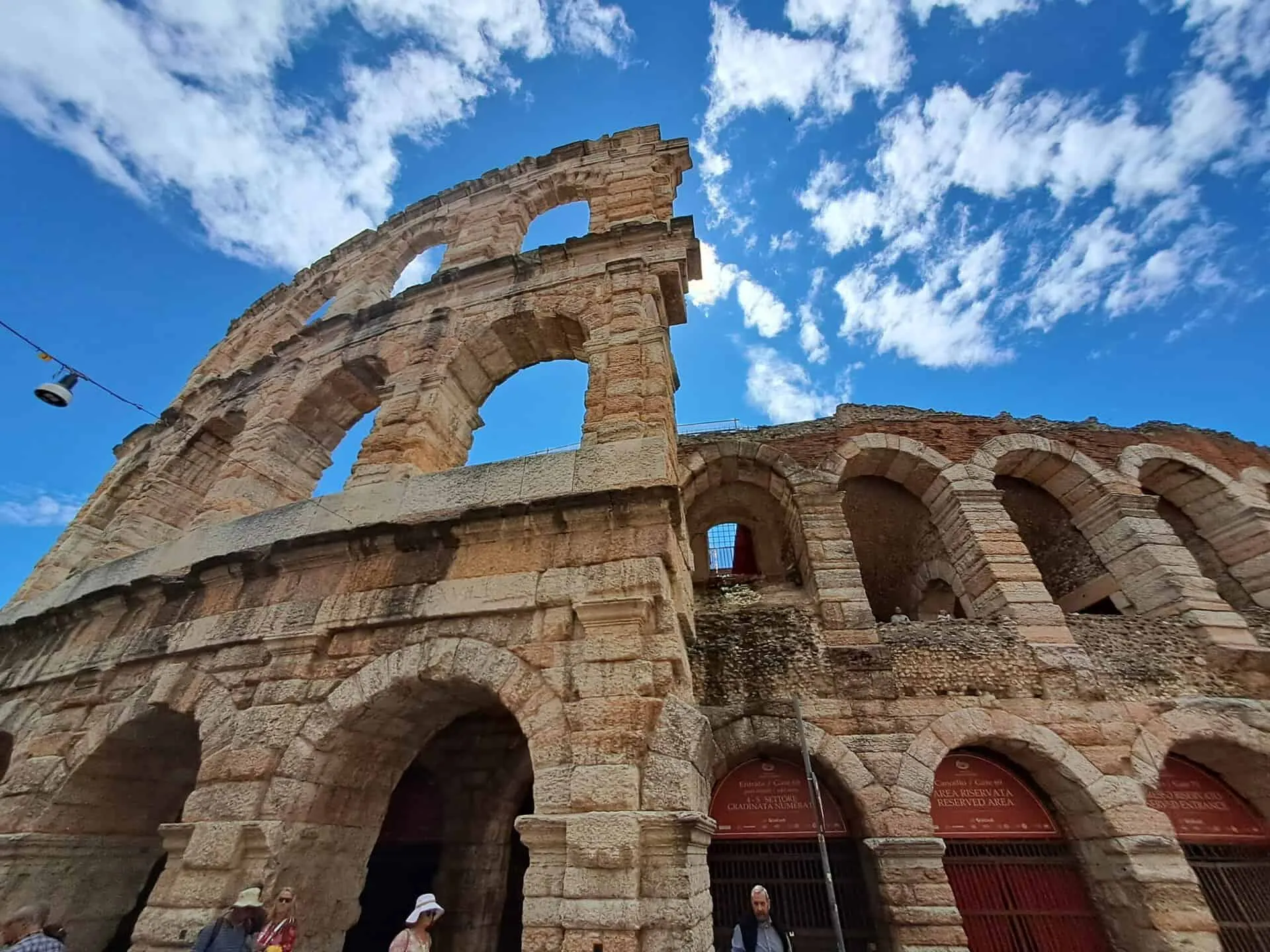
The Verona Arena is a masterclass of Roman construction meeting urban ambition. Its fabric blends limestone ashlar, opus caementicium, and a disciplined hierarchy of arches and vaults.
Overview
- Type: Roman amphitheatre (elliptical)
- Primary materials: Verona limestone, lime mortar, opus caementicium
- Key systems: Arcades, radial vaults, cavea tiers, vomitoria
The Arena’s build is a coordination of geology, geometry, and governance — a 1st–2nd century project with millennia of service.
🪨 Quarries, Transport, and Materials
- Local limestone: Verona’s quarries supplied durable blocks; density balanced strength and workability.
- Opus caementicium: Roman concrete used in cores and vault backs; lime + pozzolana.
- Iron ties (selective): Non-visible cramps ensured local continuity; monitored today for corrosion.
- Timber: Temporary centering and scaffolds; recovered and reused.
| Material | Source | Property | Use |
|---|---|---|---|
| Limestone | Local quarries | Compressive strength, weathering | Facing, arches |
| Lime mortar | Kilns | Breathable, plastic | Bedding, joints |
| Concrete | Lime + aggregate | Mass, stiffness | Cores, vault backs |
| Timber | Regional forests | Flexibility | Centering, scaffolds |
🧱 Wall Fabric and Joints
- Ashlar courses: Regular bed joints promote even load paths.
- Lime mortar: Breathable, accommodating micro-movements over centuries.
- Weep detailing: Joints and drips mitigate capillary rise.
- Anathyrosis: Dressed perimeter of stone contacts to improve fit.
🧩 Arches, Vaults, and Thrust Management
- Perimeter arcades: Repetitive arches create a lateral rhythm that locks the perimeter.
- Radial vaults: Carry crowds to seats while knitting the ring structurally.
- Buttress effect: Exterior walls act as continuous buttresses against vault thrust.
$$ ext{Vault thrust} propto rac{w cdot l}{h} quad ext{(schematic relation)} $$
🛠️ Construction Sequencing
- Perimeter foundation ring set first to ensure geometry.
- Arcade bays erected bay-by-bay; centering reused.
- Radial stairs and vomitoria carved into mass; vaults dry-tested.
- Cavea completed from lower to upper tiers.
- Finishes and drainage refined; commissioning.
Logistics synchronized quarry output, river barges, and urban staging — a Roman supply chain centuries ahead of its time.
📋 Quality Checklist (Roman Context)
- Stone dressing tolerances within target
- Mortar cure and humidity checks
- Centering stability tests
- Vault load trials before opening
Timeline (Simplified)
| Phase | Focus | Outcome |
|---|---|---|
| Foundations | Ring continuity | Geometry locked |
| Arcades | Arches + piers | Lateral rhythm |
| Circulation | Stairs + tunnels | Crowd-ready fabric |
| Seating | Cavea tiers | Operational capacity |
The outcome is a fabric that reads calm in section and ordered in elevation — the Roman recipe for longevity.
[^sources]: Archaeological campaigns in Verona confirm lime mortar composition and block typologies.
Σχετικά με τον συγγραφέα

Verona Arena Editorial
Ως λάτρης της Βερόνας και ταξιδιωτικός συγγραφέας, δημιούργησα αυτόν τον οδηγό για να βοηθήσω τους επισκέπτες να νιώσουν το πνεύμα της Αρένας — ρωμαϊκή μηχανική που συναντά σύγχρονη μουσική, σε μια αγκαλιά πέτρας και τραγουδιού.
Tags
Comments (0)
Loading comments...